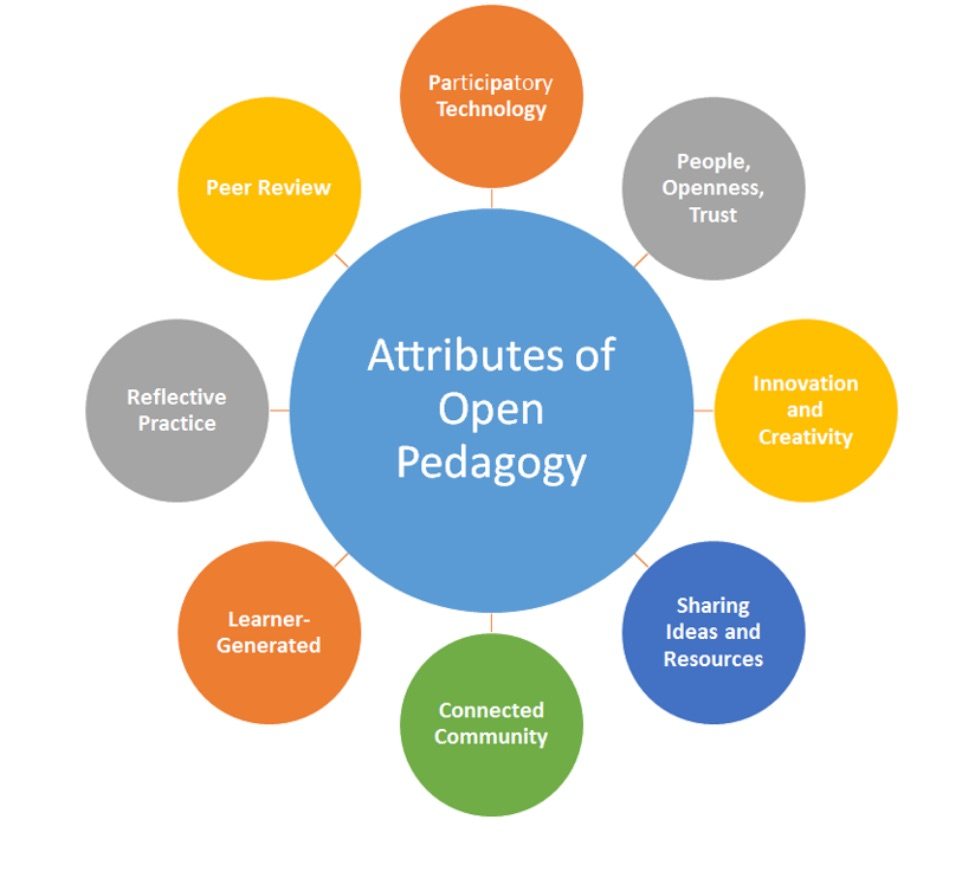
Open pedagogy (OP) prioritizes open resources and processes to ensure equitable access for anyone who wishes to learn (University of British Columbia, 2025). This learning design aims to challenge uninclusive knowledge and beliefs with the hopes of empowering and inspiring learners to create the change they wish to see. OP can take place in many environments; with the rise of the internet, social media, and blogs, this design has helped learning environments evolve into exceptionally accessible resources (Short et al., 2024). OP focuses on learners collaborating, providing feedback, and even self-publishing; from this approach, learners gain a level of agency over their work and experience in ownership.
Learning Design Alignment
For my pod’s interactive learning design resource, we chose the topic of climate change to inform youth of the deeply complex issue that is intertwined with many systems we rely upon. There are times throughout the learning resource that we will provide open-ended input responses to get learners to reflect and explore how climate change has shown up in their lives and what they might do to help. This type of learning design runs very closely to OP and would be very useful to implement throughout our learning resource to promote learners’ ability to reflect and provide feedback after exploring their ideas.
Our learning resource will align with the OP goals of keeping resources open and accessible to those who wish to learn. The platform we plan to use, WordPress, is an open site that does not require a subscription for the learners to take part; any other resources that will be used or referenced, like YouTube videos, articles, and quizzes, will be open to anyone who may wish to partake.
The self-publishing aspect of OP fits in with the topic of climate change and is something that should be emphasized, as the issue is quite pressing and in need of advocacy. Although, for our learning resource, we won’t be suggesting learners participate in online discussions or discourse during or after the course. Of course we aren’t in a place to forbid it, but as our group has all experienced, the internet’s feedback to anything climate-change-related is not usually positive or empathetic. Instead, we wish to encourage learners to talk about climate change in their community and consider local initiatives so they can become more aware and considerate with respect to our lands and ecosystems.
References
Short, C. R. et al. (2024). Higher education instructors’ perceptions of open pedagogy: an exploratory study of open pedagogy definitions in practice. Open Learning, 1–16. https://doi.org/10.1080/02680513.2024.2334237
University of British Columbia. (2025). What is Open Pedagogy. Program for Open Scholarship and Education. https://pose.open.ubc.ca/open-education/open-pedagogy/defining-open-pedagogy/
I really like how clearly you connected open pedagogy to our climate change blueprint. The emphasis on learner agency, open-ended reflection, and accessibility fits perfectly with what we’re trying to do with the resource, especially using WordPress as an open platform for learners will make it really helpful and accessible to many people. I also appreciate the point about encouraging community based conversations rather than online discourse, that feels thoughtful and more realistic given the topic we chose. Im super excited to see where this will end up !!!